
How Hubbell Helped a Global Automaker Combat Corrosion
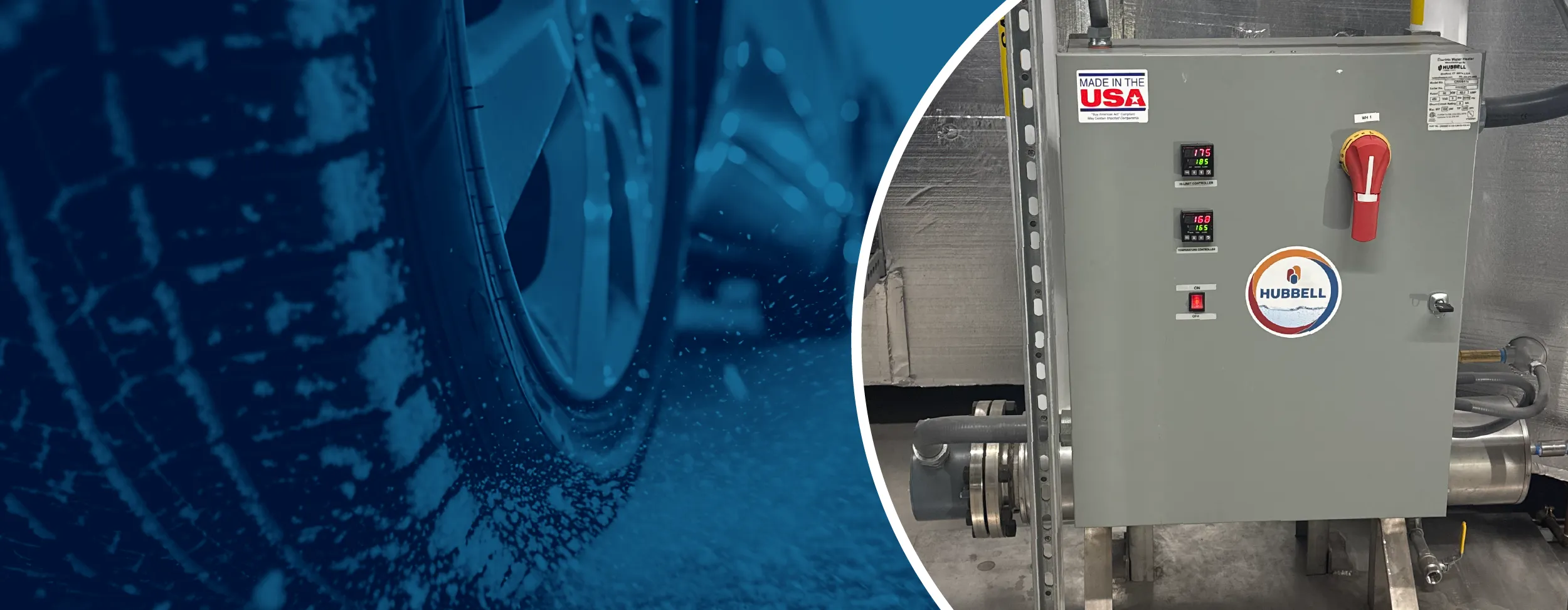
Background
Corrosion costs US motor vehicle owners an astonishing $23 billion dollars a year, according to the Federal Highway Administration. The good news is that up to 35% of these costs can be prevented through improved protection strategies and testing. Recognizing this, auto makers have shifted toward more aggressive, cyclic testing mandates. Today, we’ll look at how Hubbell helped a global auto manufacturer meet these evolving standards with a high performance, custom engineered heating solution.
While corrosion guidelines have been in place for several decades, recent updates have increased the requirements. Historically, the auto industry relied on relatively simple salt spray tests. The newer standard, known as Cyclic Corrosion Testing (CCT), is broader and more stringent. In addition to just salt, they now cover humidity, high temperature drying and other conditions.
The Need
Greenfield Dynamics, a leading commercial HVAC and plumbing equipment manufacturer's representative, partnered with Hubbell to help a global automaker upgrade their corrosion testing facilities to comply with the updated regulations. Specifically, the manufacturer needed to test a vehicle’s undercarriage, paint, and other exposed components for corrosion resistance.
The solution was to build a corrosion chamber that tests for resistance under various conditions. The chamber would simulate salt spray, fog, freezing, dirt/grime, extreme temperatures and even hurricane force winds. To effectively achieve this, multiple processes needed to be incorporated into the chamber. High humidity and salt exposure simulation, for example, required hot water.
The guidelines were new, and deadlines were tight. The manufacturer required an industrial water heating solution that met the following criteria:
- Made from Durable Materials - all wetted parts and pressure vessels needed to be constructed from corrosion resistant materials to prevent pitting and crevice corrosion. System controls needed protection from salt mist, high-pressure washdowns, and chemical vapors.
- Flexible, High-Capacity Power - the application required a range of heating outputs to accommodate rapid temperature increases across various chambers.
- Precise Control – to meet strict tolerances, the system needed “infinite” variable control to maintain exact humidity and temperature while testing.
- Communications Requirements - the heating solution needed to be compatible with the manufacturer's existing RS485 communication protocols to allow for seamless integration into their testing facility.
- Small Footprint – as testing space was limited, the manufacturer required that it take up as little room as possible.
- Short Ramp-Up Time – since deadlines were tight, the heating system needed to be up and running quickly once delivered.
Product Highlight
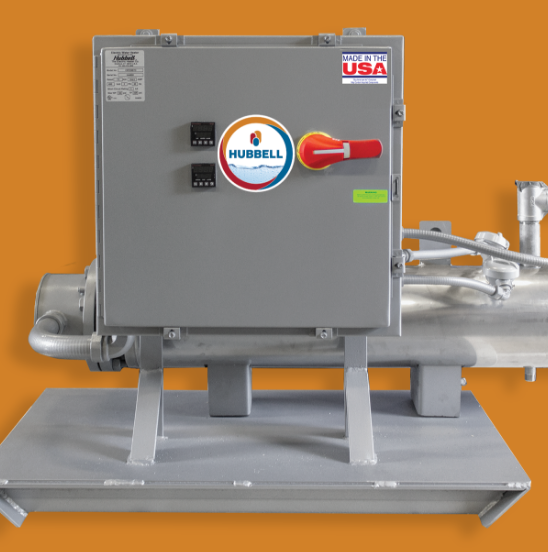
Signature Series CRComplex industrial application? We’ve got a solution for you. Our Signature CR instantaneous models are highly customizable with a range of operating controls, materials, and design styles. Constructed to meet the specific requirements of your system — for even the most demanding scenarios.
The Solution
Within a short period of time, Hubbell and Greenfield engineered and delivered a high-performance heating solution that met the manufacturer’s requirements. The Hubbell Signature CR instantaneous circulation water heater was chosen for its corrosion proof properties, precise control mechanisms, and its customization capabilities. Three systems were supplied in total, one for each required heating output, 20kW, 25kW, and 50kW.
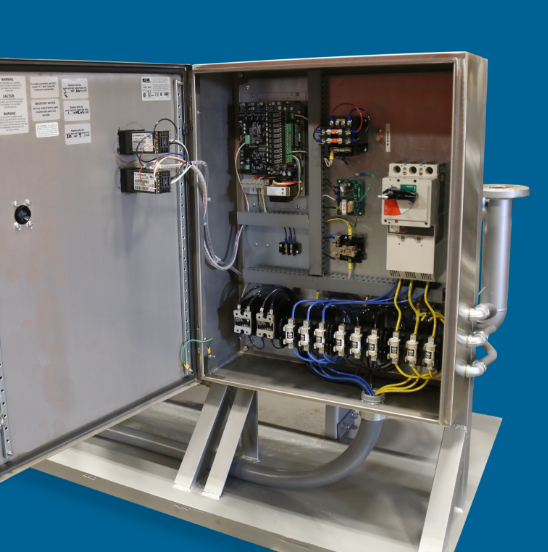
- Each system consisted primarily of a circulation heater, vessel and control panel.
- To meet the limited space requirements and get the heaters in service quickly, each unit was skid mounted, pre-piped, and pre-wired.
- To withstand Acetic Acid and Copper-Accelerated salt sprays (CASS/AASS), the heater elements and vessels were constructed from 316L stainless steel.
- The controls were equipped with RS485 communications, allowing for precise control and seamless integration into the customer’s PLC/SCAFA systems. The SCR control allows for precise temperature control and power modulation of progressive heating elements. All controls were housed NEMA 4x rated enclosures to ensure that they won’t rust or degrade when exposed to salt and other corrosive threats.
Conclusion
As automotive engineering continues to evolve, so will the need for high-powered process equipment. By integrating Hubbell’s Process CR circulating heaters into their testing infrastructure, this global auto manufacturer can now reliably test for corrosive threats and comply with newer regulations. With 316-L stainless steel construction, excellent control, and other material considerations, this custom solution ensures that the OEM can continue to design and deliver vehicles that can withstand the harshest environmental conditions.