
NEC/CEC Hazardous Classifications: Classes, Divisions and Groups
Hubbell Heaters is an American based manufacturer of explosion-resistant (ER) water heaters. These heaters are used in applications where controlled heat is required for multiple liquid types, including domestic/waste/RO/DI/CIP water and other thermal fluid systems for refining, chemical, and other industrial processes. Environmental conditions at the heater’s installation point within a plant or facility often drive the need for an ER design.
When helping customers with the design and sizing of a water heater, we are often asked about hazardous location classifications and requirements. Similar to the different measurement systems of Imperial and Metric units, there are two main hazardous area classification systems, Class or Zone. Hubbell most commonly adheres to the North American Class system which is discussed in this post. Please consult the factory for equipment in compliance with the Zone system per ATEX and IECEx requirements if needed.
Below is an outline of the required process information and how it relates to the Hubbell Heaters ER product lines. We will review the following:
- Class
- Division
- Groups
- T Codes
- Process Required Data
Hazardous Area Classification (Class–Division–Group–T-Code)
The Hazardous Area Classification helps determine what type of electrical equipment is safe to use in locations where fire or explosion hazards may exist due to flammable gases, vapors, dusts, or fibers. The Class system is most commonly specified in North America and is defined by the NFPA (National Fire Protection Agency), NEC (National Electric Code), and CEC (Canadian Electric Code). It is made by assessing the Class, the Division, the Group and the T-Code. All of which are explained below.
Class: Describes what type of hazard

Division: Defines the likelihood of a hazard

Group – Explains what material is present
Class I Groups: Gases/Vapors

Class II Groups: Dusts

Class III Areas: do not use a group designation
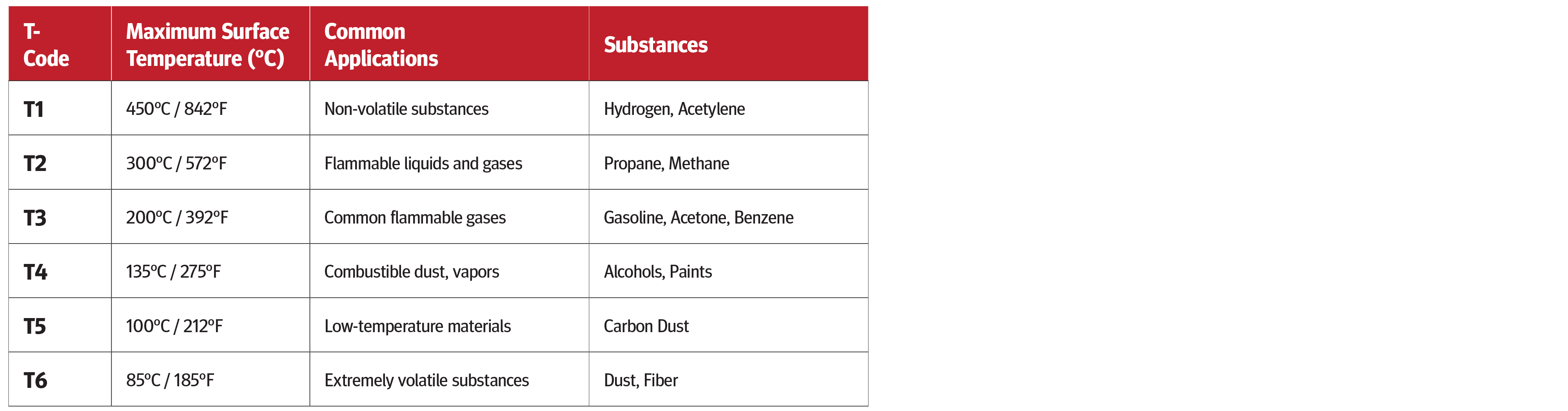
T-Code – Maximum Surface Temperature of equipment
Within any hazardous environment, it is crucial that the maximum surface temperature of an electrical heater housing does not exceed the auto-ignition temperature of the potentially explosive atmosphere. All explosive substances have a defined Auto-Ignition Temperature (AIT), which allows it to be assigned to a corresponding Temperature Class. The temperature class refers to a specific T-code that helps define the hazardous area.
Classification Example
Class I, Division 1, Group D, T3
- Class I: Flammable gases/vapors
- Division 1: Likely present during normal operation
- Group D: Common hydrocarbons (propane, gasoline)
- T3: Equipment surface temperature must stay at 200°C / 392°F or lower
Hubbell Electric Heaters offers various options, but our standard designs are based on:
· Class I, Division 1 & 2, Groups B, C, & D, T5
· Other options may be available
Process Required Data
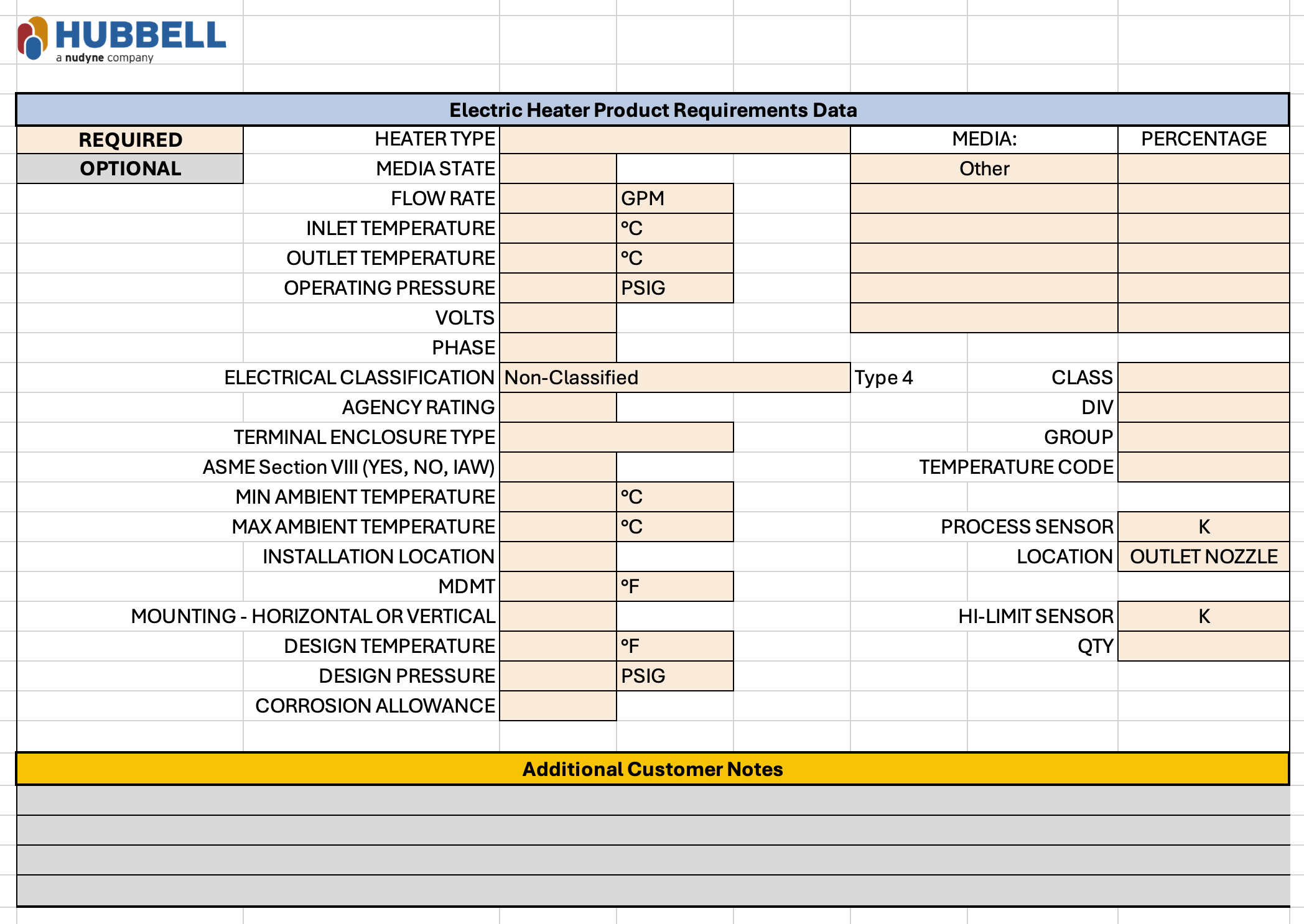
To help you determine the best water heater for your location, we start with a Process Required Data document (see sample below). By gathering this level of detail about the process conditions and intended application usage, customers can select a thermal solution that is properly sized and matched to the application. Each project's scope can be different, and this is where Hubbell Heaters' experience and engineering-focused designs allow for turnkey, project-driven results.
Hubbell Heaters Product lines that use our ER solutions:
Hubbell Heaters is unique in its custom capabilities and offerings around ER water heating solutions. To contact a technical sales representative or to learn more about our capabilities please contact us.