What is Deionized Water? Conductivity, DI Process, & Material Selection
What Is Deionized (DI) Water?
Deionized water, commonly known as DI Water, is ultra pure, neutral water. It is void of impurities such as calcium, chlorides, iron, magnesium, sodium, aluminum, and other minerals. The absence of these ions significantly increases the purity of the water, which minimizes the risk of unwanted chemical reactions occurring.
Electrical Conductivity
We can’t have a discussion about DI water without mentioning conductivity. The principle is fairly simple: the lower the purity of the water, the more easily it conducts electricity. This results from the higher salt and/or mineral content. Is this a help or hindrance?
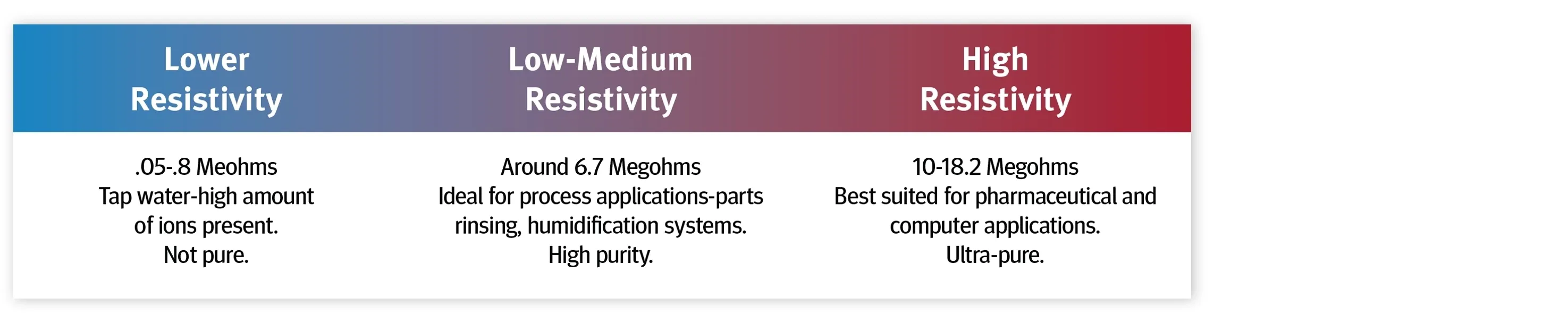
It depends on the requirements of the application. And while we are on the topic of conductivity, let’s quickly talk about resistivity. This is the inverse of conductivity. More specifically, it is the measure of how strongly water resists the flow of electrical current. It’s typically expressed in ohm-centimeters (Ω·cm) or megohm-centimeters (MΩ·cm). The higher the resistivity, the purer your water because there are fewer ions present.
Common Applications of DI Water
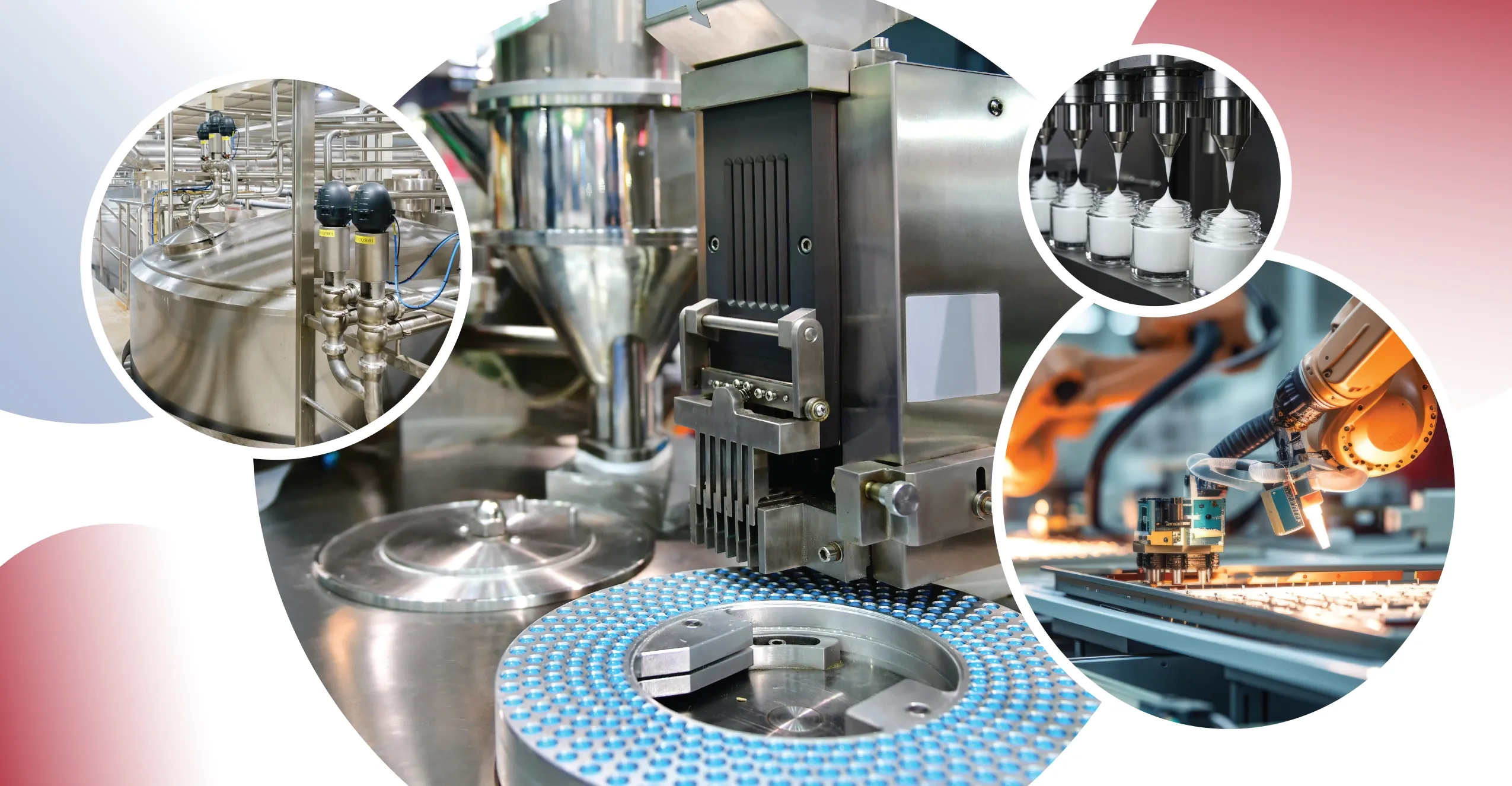
Reverse osmosis/deionized (RO/DI) water is ideal for uses when water with zero “unknowns” is needed. Typical applications range from simple parts washing to more demanding ones
in the pharmaceutical, medical, electronic, and food service industries. Below are some specific examples.
- Medical & Pharmaceutical – used to make sterile solutions, clean surgical tools, and as an ingredient in medications where impurities can’t be present.
- Electronics & Semiconductor Manufacturing – rinses wafers and other delicate components to ensure that no conductive ions or mineral deposits interfere with circuits.
- Cosmetics & skincare production – A pure and neutral water base is a must to ensure product stability and consistency without undesired reactions from minerals or chlorine.
- Hydroponics & Controlled Agriculture – growers start with RO/DI water, then add back precise nutrients to this clean base, giving them consistency and complete control.
The DI Process
We could easily produce a separate eBook detailing the deionization process, but since we’re doing quick facts, today we’ll look at the high-level process steps:
- Mechanical filtration – during this initial phase, particulates are mechanically removed from the water.
- Adsorption (carbon) – next, the water passes through carbon, which removes chlorine, chloramine, and organics.
- Membrane separation (RO) – then the water passes through a semi-permeable barrier, where ~95–99% of dissolved ions and molecules are removed via reverse osmosis. We’re almost there!
- Ion exchange (DI) – finally, the last trace ions are removed by swapping them for H+ and OH-, yielding pure H₂O.
How Does Deionization Measure Up to Other Purification Methods?
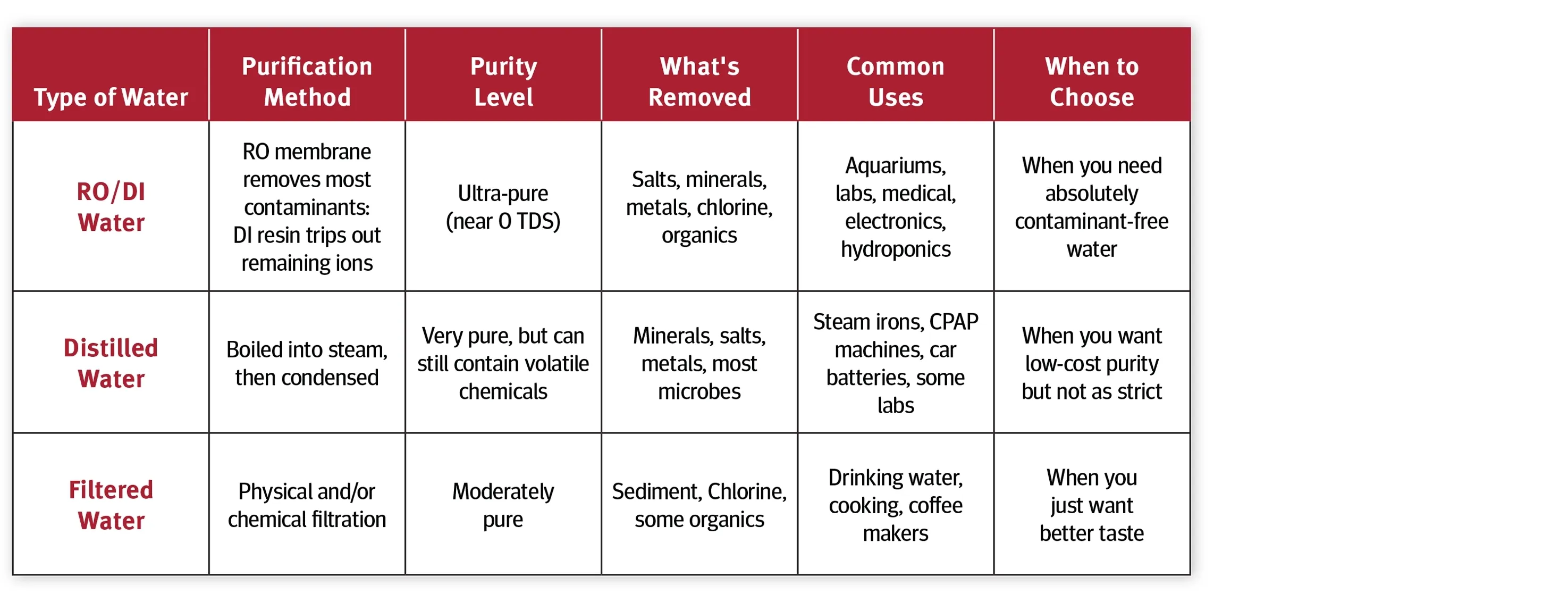
In addition to DI, users of purified water may also consider distilled water or filtered water. Let’s take a quick look at these two processes.
- Distilled Water – is boiled into steam, then condensed. Great for less demanding applications where low-cost purity is needed, such as irons and CPAP machines.
- Filtered Water – is either physically or chemically filtered. It works well when better tasting water is desired, such as coffee making and cooking.
Water Heater Material Options
There’s certainly no shortage of material options when it comes to water heaters. Many consumers looking for an RO/DI water heater assume they need expensive construction materials such as titanium or Teflon® coating, but there are other options that yield the same results. Conversely, other options may save some money, but not provide acceptable results. Options typically include:
- Cement – while this could be more budget friendly, unfortunately, cement contains minerals that will leach into and contaminate the water.
- Glass – on quick thought, this seems like a great option. But in reality, glass is porous and breaks down quickly as a result. They also require anode rods made of metals which contaminate, and work against the mission for purity.
- Stainless Steel – is one of the best choices as it resists corrosion, lasts long, and is economical. It’s the trifecta, offering most consumers the perfect balance between performance and cost.
Product Highlight
UltraPure Series HDSensitive applications demand high-purity water. Ultrapure HD is built to support RO/DI water systems, maintaining integrity over time. The solid 316L stainless steel ASME stamped pressure vessel resists corrosion and ensures longevity.


Stainless Steel: The Cost-Effective Choice
If your purified water application requires ultra purity and consistency, without surprises –you’ll need RO/DI water. More demanding applications may need higher-grade materials. But for most uses, stainless steel is the better option – delivering reliability without the sticker shock.