
Industrial Process Water in Demanding Applications
What is Industrial Process Heating?
In simplest terms, industrial process heating is the application of heat to water, fluids or gases as part of a manufacturing process. It is typically used for washing components, sterilizing equipment, maintaining chemical reaction temperature, or prepping materials for further processing.
The process is often facilitated by an industrial on-demand water heater. These types of heating solutions are designed to quickly and precisely heat water for specific processes. The heater consists of a pressure vessel, electric heating elements, controls and sensors, as well as inlet/outlet connections. It’s important to note that on-demand systems do exactly what the name implies: it heats the water on demand, as opposed to storing large amounts of water.
Let’s look at some typical applications:
Medical Device Manufacturing
It probably doesn’t come as a surprise to hear that medical device manufacturing presents the strictest industrial heating requirements. Medical devices must be sterile to prevent infections and other complications when in use. There's zero tolerance for contamination. Meeting this demand requires several considerations. First, the water must be ultra-pure with high resistivity levels. Precise temperature control is also required. To help ensure sterility, stainless steel with a mirror finish is typically required. Water heaters in medical device manufacturing also need to be free of visible weld marks, since these are great places for contaminants to hide.
A quality medical-grade heater must meet the requirements of the ASME Boiler and Pressure Vessel Code to ensure both safety compliance and the material quality necessary for ultra-pure applications. Reliability is critical. Downtime doesn't just cost money, it can impact operations, which could ultimately affect the end user’s ability to meet patient needs.
Semiconductor Manufacturing
Semiconductor production requires heating solutions that deliver one thing above all: consistency. Semiconductor manufacturers use hot water to wash printed circuit boards. Additionally, hot water may be used in chemical mixing processes. Chip production facilities tend to run 24/7, leaving no room for downtime. So heavy duty construction and reliability are critical factors for industrial machinery used in semiconductor production.
One other notable requirement for chip manufacturing, and similar production applications, is scalability. Currently, the semiconductor industry is experiencing rapid growth, with forecasts projecting sales to hit $1 trillion by the early 2030’s, according to McKinsey & Company. As product demand grows, so must water heating capacity. Certain industrial heaters can be configured in series or parallel arrangements, allowing users to achieve higher energy output without replacing the entire system.
Clean-In-Place (CIP) Systems
CIP systems allow for automated cleaning of interior surfaces of pipes, vessels, processing equipment and tanks without taking the system apart. They are typically found in facilities that produce beverages, pharmaceuticals, and dairy products. CIP systems require rapid heating to sterilization temperatures and must also cycle many times in a day.
Another key requirement for CIP systems that they must be able to connect and communicate with process control systems. This gives them the ability to collect temperature and flow rate feedback and adjust accordingly.
What Makes a Good Industrial on Demand Water Heater?
While the applications for industrial process heating are diverse, there are several common requirements including robust construction, scalability, and integration capabilities. Above all, the most valuable feature of a well-designed process heater is adaptability. For straightforward applications, it's plug-and-play simple. For complex processes, the heating unit should be able to handle more demanding requirements such as advanced monitoring, feedback controls, and full system integration such as Building Automation and Control Networks (BACnet). BACnet is a widely used communication protocol in building automation systems. It enables integration between Building Control Systems (BCS) and third-party devices for:
Input/output (I/O) monitoring
- Alarm management
- Setpoint and limit control
- Trend logging
- Equipment status monitoring
Regardless of your application, be sure to choose a high quality, reliable industrial water heater that is engineered for versatility, built with quality materials, and designed to last.
Looking for a reliable on-demand water heater that adapts to your specific needs?
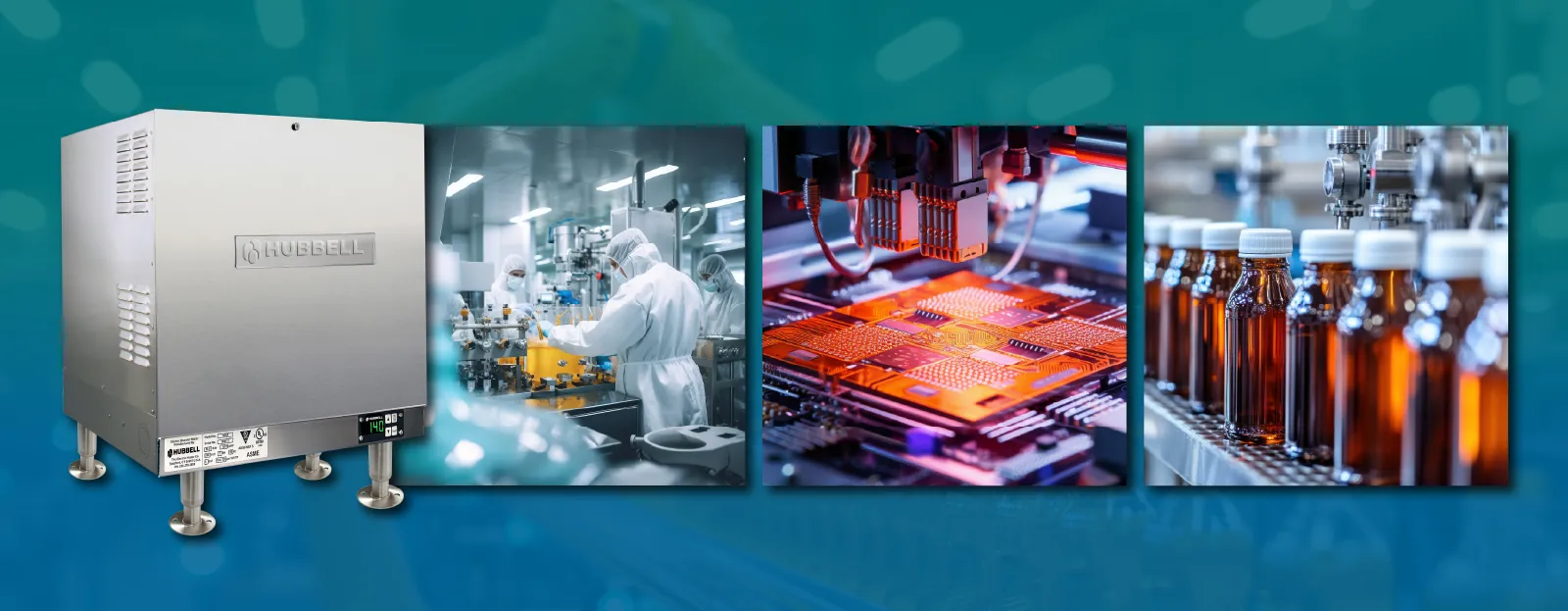
Check out the Hubbell Process V industrial water heater. It’s versatile, reliable, and meets the needs of today’s industrial processes. Thanks to its stainless-steel construction the Process V is known for its durability and longevity. It is available in all voltages, single or three phase up to 88kW and comes in 6- or 16-gallon capacities and meets the requirements of the ASME Boiler and Pressure Vessel Code. It offers scalability and comes with an optional BACnet communication module with a digital controller. The Process V is designed to handle the needs of any application — from simple to complex.
Looking for a RO/DI solution in your industrial process?
The UltraPure HD gives you the same power and versatility as our Process V, but it’s made specifically for RO/DI water.
Contact us today to discuss your industrial heating needs and learn why global manufacturers trust the Process V for their critical industrial heating needs.